
Roman Zao (Zakharchenko)
Independent artist-researcher in visual culture and tattoo art
Master of Fine Arts (Graphic Design), Far Eastern Federal University
Email: Roman.Zao.ink@gmail.com
ORCID: 0009-0003-5561-6339
UDC 7.036:391.91
12 January 2023
Keywords: color in tattooing, pigment, skin, blood undertone, visual perception, body art, visual culture, practice-based research
Color in tattoo art constitutes a complex visual and perceptual phenomenon that cannot be examined solely through the framework of classical color theory. Unlike painting, graphic art, or digital media, tattoo color emerges through the interaction of multiple variables: pigment, skin surface, and the blood undertone inherent to the human body. This interaction transforms color in tattooing into a dynamic system that evolves over time and is directly influenced by physiological and anatomical factors.
Contemporary research in visual studies, body studies, and perceptual psychology emphasizes that skin functions as an active mediator of color rather than a neutral surface. Blood undertone, skin density, pigmentation level, and individual physiological characteristics significantly affect the final visual perception of a tattoo. Consequently, color in tattoo art cannot be considered a fixed attribute of the image; instead, it represents the outcome of a complex optical and biological interaction.
Within the framework of practice-based analysis, particular attention is given to the role of blood undertone, which establishes the foundational chromatic background of the skin. Visually, this undertone may be perceived as warm, cool, or neutral, directly influencing pigment behavior. The same pigment color, when applied to skin with different undertones, exhibits varying degrees of saturation, depth, and emotional resonance.
Pigment introduced into the dermal layer interacts with blood undertone not only during the healing phase but also over the long term. Optical changes occur over time due to light diffusion, skin regeneration, and variations in tissue blood supply. This makes temporality a critical factor in the analysis of color in tattoo art. Color decisions must therefore account not only for immediate visual impact but also for the potential transformation of the image over time.
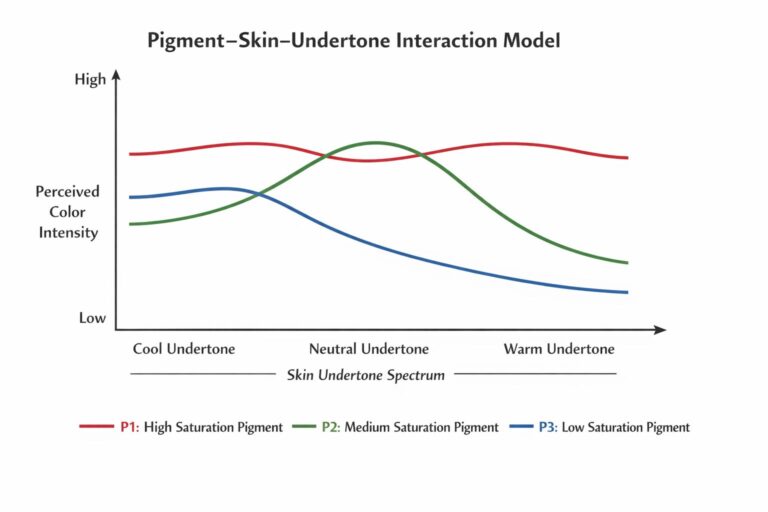
To conceptualize the interaction between pigment, skin, and blood undertone, the study employs the following analytical model.
Figure 1. Pigment–Skin–Undertone Interaction Model (conceptual graph)
Vertical axis (Y): Perceived color intensity
Horizontal axis (X): Skin undertone spectrum (cool – neutral – warm)
Curves:
P1 — high-saturation pigment
P2 — medium-saturation pigment
P3 — low-saturation pigment
Interpretation:
The model illustrates how identical pigment saturation levels produce different perceived color intensity depending on skin undertone. High-saturation pigments (P1) demonstrate greater stability across undertones, while low-saturation pigments (P3) exhibit significant perceptual variability, particularly on warm undertones.
This model highlights a fundamental distinction between tattoo color perception and planar artistic practices. In tattoo art, color functions not as an absolute value but as the result of biological and visual interaction. This condition requires the tattoo artist to possess not only knowledge of color harmony but also an understanding of the corporeal nature of color.
Color in tattoo art also performs emotional and cultural functions. Research indicates that specific color solutions are interpreted differently depending on bodily context and individual perception. In this sense, blood undertone operates as a latent bio-cultural layer that influences both the emotional response of the viewer and the embodied experience of the tattoo bearer.
Analysis of practical and research material suggests that working with color in tattoo art represents a form of visual forecasting. Artistic decisions are developed with consideration of physiology, temporality, and individual bodily characteristics, distinguishing tattooing from most other forms of contemporary art.
Thus, the interaction of pigment, skin, and blood undertone constitutes a fundamental factor in the formation of color decisions in tattoo art. Understanding color as a dynamic, body-conditioned system enables tattooing to be interpreted as a complex interdisciplinary practice situated at the intersection of art, biology, and visual culture.
References
-
DeMello, M. (2014). Inked: Tattoos and Body Art around the World. Santa Barbara: ABC-CLIO.
-
Pitts, V. (2003). In the Flesh: The Cultural Politics of Body Modification. New York: Palgrave Macmillan.
-
Featherstone, M. (2010). Body, image and affect in consumer culture. Body & Society, 16(1), 193–221.
-
Sweetman, P. (2004). Anchoring the (postmodern) self? Body modification, fashion and identity. Body & Society, 10(2–3), 51–76.
-
Jones, C. A. (2011). Body Art/Performing the Subject. Minneapolis: University of Minnesota Press.
-
MacCormack, P. (2008). The Anatomy of Disgust. London: Continuum.
-
Pitts-Taylor, V. (2016). The Brain’s Body: Neuroscience and Corporeal Politics. Durham: Duke University Press.

- The Poem Hidden Inside Someone Else’s Page - July 20, 2026
- After 14 Years, We’re Finally Getting a James Bond Game - June 17, 2026
- Serhiy Tokarev on TechNovator’s Victory in Deep Tech Accelerator - June 9, 2026