
Roman Zao (Zakharchenko)
Independent artist-researcher in visual culture and tattoo art
Master of Fine Arts (Graphic Design), Far Eastern Federal University
Email: Roman.Zao.ink@gmail.com
ORCID: 0009-0003-5561-6339
UDC 77.01:7.038:391.91
December 3, 2025
Keywords: photography, tattoo art, visual documentation, visual studies, body art, research methodology, practice-based research, visual analysis
In contemporary visual culture, photography occupies a significant position not only as an artistic practice but also as a research instrument. Within the context of tattoo art, photography acquires particular methodological importance, as it enables the fixation of a corporeal artistic expression that exists under conditions of movement, temporality, and individual anatomy. Consequently, photography functions not as an auxiliary tool but as a central analytical method in the study of tattoo art.
This article examines photography as a research instrument in tattoo studies through interdisciplinary approaches drawn from visual studies, photographic theory, and body studies. Photography is considered as a means of analyzing form, composition, color, and the interaction between image and body, as well as a method for documenting temporal and social transformations of tattoo imagery.
One of the primary challenges in tattoo research lies in the instability of the tattoo as a visual object. Unlike painting or sculpture, tattooing exists within a constantly shifting environment shaped by bodily movement, changes in lighting, anatomical transformation, and the passage of time. Photography allows this dynamic process to be temporarily stabilized, creating fixed reference points essential for comparative and analytical investigation.
Photographic documentation of tattooing performs several research functions. First, it enables compositional and anatomical analysis outside the dynamic context of the moving body. Second, photography facilitates longitudinal comparison of tattoo images across different stages, including immediately after application, post-healing, and over extended periods of time. Third, photographic material supports cross-cultural and cross-stylistic analysis by providing standardized visual data.
Visual studies emphasize that photography is not a neutral reflection of reality but constructs its own visual narrative shaped by framing, lighting, focal length, and contextual presentation. In tattoo research, this aspect becomes especially significant, as photography not only records the tattoo but also interprets it, foregrounding specific dimensions of bodily and artistic interaction.
As a research tool, photography also enables analysis of the social dimension of tattoo art. The circulation of tattoo photographs within media, academic publications, and visual archives transforms tattooing from an individual bodily practice into an object of collective visual knowledge. In this process, photography operates as a mediator between embodied experience and social interpretation.
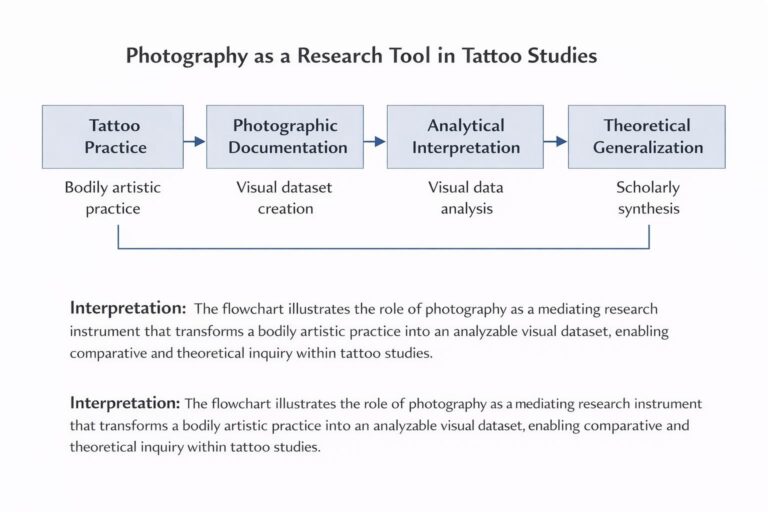
To systematize the research functions of photography in tattoo studies, the present article employs the following analytical model.
Conceptual Scheme. Photography as a Research Tool in Tattoo Studies
The use of photography within a research framework facilitates the creation of visual archives that support long-term investigation. Such archives allow for repeated analysis, interdisciplinary comparison, and theoretical generalization, which are particularly relevant for practice-based research in tattoo art.
In conclusion, photography in the study of tattoo art functions not merely as a documentary technique but as a full-fledged research instrument that enables analysis of artistic, anatomical, temporal, and social dimensions of tattooing. Conceptualizing photography in this methodological role expands the analytical possibilities of body art research and contributes to the institutionalization of tattoo art as a legitimate object of academic inquiry.
References
-
Banks, M. (2007). Using Visual Data in Qualitative Research. Sage.
-
Pink, S. (2009). Doing Sensory Ethnography. Sage.
-
Elkins, J. (2008). Visual Studies: A Skeptical Introduction. Routledge.
-
Prosser, J., & Loxley, A. (2008). Introducing Visual Methods. ESRC National Centre for Research Methods.
-
Mitchell, W. J. T. (2015). Image Science: Iconology, Visual Culture, and Media Aesthetics. University of Chicago Press.
-
Dikovitskaya, M. (2005). Visual Culture: The Study of the Visual after the Cultural Turn. MIT Press.
-
Atkinson, M. (2014). Tattooed Bodies and the Production of Subjectivity. Sociology Compass, 8(7), 934–945.

- The Poem Hidden Inside Someone Else’s Page - July 20, 2026
- After 14 Years, We’re Finally Getting a James Bond Game - June 17, 2026
- Serhiy Tokarev on TechNovator’s Victory in Deep Tech Accelerator - June 9, 2026