
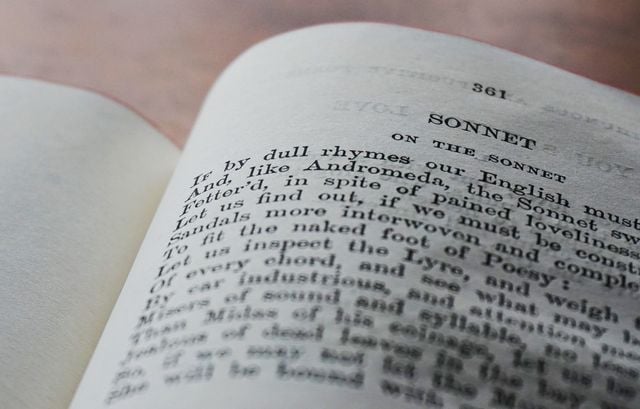
Take a paperback nobody wants anymore, a thick marker, and forty spare minutes. A reader can still pull a brand new poem out of someone else’s paragraphs.
That is the basic mechanic behind erasure poetry, a practice where most of an existing text gets blacked out, cut away, or painted over, leaving only the survivors.
The form predates the social feeds where it now circulates widely. Doris Cross began painting over dictionary pages back in 1965, an example the Poetry Foundation’s glossary on erasure still cites as one of the earliest.
Ronald Johnson erased most of Milton’s Paradise Lost to write RADI OS in 1977, a piece the Academy of American Poets points to often in its teaching materials on the form. Tom Phillips spent decades reworking a forgotten Victorian novel into the visual poem A Humument, and Jen Bervin later erased Shakespeare’s sonnets down to a handful of surviving words in Nets.
How Erasure Poetry Actually Works
Erasure poetry, built by removing most of a source text rather than adding new lines, follows a fairly consistent process no matter what material a writer starts with.
- Select a source with enough density to hide a second meaning, such as a newspaper column, a legal notice, or a discarded novel page.
- Read the full passage once without marking anything, noting words or phrases that already stand out on their own.
- Choose which words survive, usually a small fraction of the original count, and mark them lightly in pencil first.
- Remove or obscure everything else through blacking out, cutting, painting, or digital redaction, depending on the chosen medium.
- Read the surviving words in sequence to confirm the new poem holds together, then finalize the marks permanently.
Erasure Poetry Against Its Closest Relatives
The form gets confused with a few neighboring styles, though each one pulls from source material in a different way.
| Form | Source Material Handling | Visual Result |
|---|---|---|
| Erasure poetry | Removes most words from one continuous text | Blacked-out or cut page, gaps visible |
| Found poetry | Rearranges whole phrases lifted from one or more texts | Clean verse, no visible source marks |
| Cento | Stitches together complete lines from multiple different poems | Reads as one poem, sources uncredited in the body |
| Concrete poetry | Arranges original words into a shape or pattern | Typography itself forms an image |
Where the Form Shows Up Now
University writing programs teach erasure poetry alongside more traditional forms, often through short workshops where a visiting poet blacks out pages live in front of students.
Those sessions often get recorded in short clips and posted to a class account on X, then the account goes quiet once the semester ends and nobody keeps it updated.
An archivist who wants that footage for next year’s syllabus needs a way to save it before the post disappears, since departmental accounts are rarely maintained past a single term.
For that kind of save, sssTwitter works as a plain twitter video downloader free tool, needing nothing beyond a pasted link and a few seconds, no account or install required.
Erasure poetry has always been about what gets kept and what gets removed. Saving the record of how a poem got made is the same instinct, aimed at process instead of page.

- The Poem Hidden Inside Someone Else’s Page - July 20, 2026
- After 14 Years, We’re Finally Getting a James Bond Game - June 17, 2026
- Serhiy Tokarev on TechNovator’s Victory in Deep Tech Accelerator - June 9, 2026