
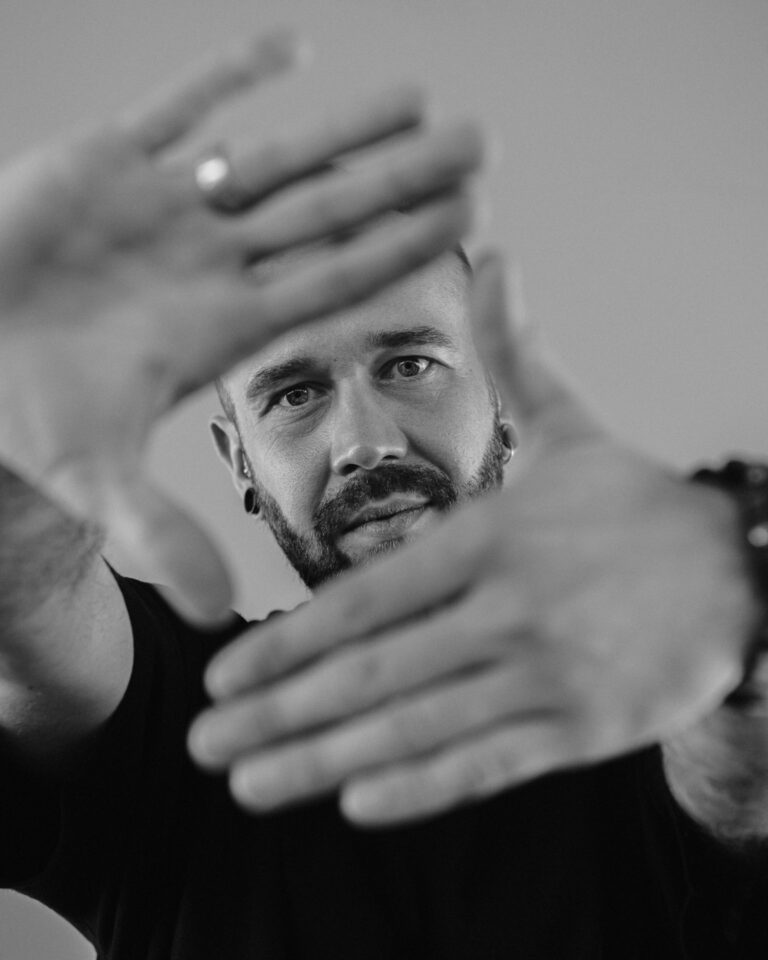
Tattooing is increasingly moving beyond the boundaries of industry practice and becoming an object of serious interdisciplinary analysis — at the intersection of art, anatomy, psychology, and visual culture. We spoke with Roman Zao, tattoo artist and researcher, about his long-term research program, how practice evolves into inquiry, and why contemporary tattooing demands not only skilled hands, but sustained thinking.
— Roman, in recent years you’ve increasingly spoken about tattooing as a subject of research. When did you realize that practice alone was no longer enough?
— It wasn’t a sudden realization. It happened gradually. When you work with bodies, images, and people for a long time, you start noticing recurring patterns. How the same image behaves differently on different bodies. How color changes over time. How people change after getting tattooed — not immediately, but months and years later. At some point, I understood that these weren’t just observations anymore. They were material that required interpretation.
— So your research program emerged directly from practice?
— Yes, absolutely. I never set out thinking, “I’m going to become a researcher now.” I simply began documenting what I was seeing. Comparing. Reading the work of others — psychologists, art theorists, body researchers. Over time, it became a system. Today, I can say that I have a research program that has been developing for many years.
— How would you describe the core of this program in simple terms?
— I study tattooing as an art form that exists not on a flat surface, but within the human body. I’m interested in how anatomy shapes composition, how color interacts with skin, how images change through time and movement. And just as importantly, how tattooing affects people psychologically and socially.
— You often emphasize anatomy as a key factor. Why is it so central?
— Because the body is not a neutral surface. It has geometry, rhythm, and dynamics. The same image becomes a different artwork on different bodies. If an artist ignores that, they’re working blindly. For me, anatomy isn’t a limitation — it’s part of the artistic language.
— Your research also focuses heavily on color. What questions are you exploring there?
— Color in tattooing can’t be approached the same way as in painting or graphic art. It always interacts with skin — its tone, density, and reaction to pigment. I’m interested in how color perception changes over time, how it affects a person emotionally, and how cultural context shapes color choices.
— When did psychology enter the focus of your research?
— Almost immediately. I kept seeing that tattooing affects more than a person’s appearance. It changes self-perception, confidence, and the way people interact with others. I wanted to understand what actually happens after a tattoo — not in the moment, but over the long term. It’s a deeply underestimated area.
— Do you rely primarily on your own experience, or do you work within a broader research context?
— Relying only on personal experience would be insufficient. I constantly engage with the work of other researchers — psychologists, cultural theorists, artist-scholars. It’s important for me to situate my observations within what’s already been studied and articulated. My practice is one case within a much larger field, not an isolated example.
— Why do you think it’s important to approach tattooing from a research perspective today?
— Because tattooing has long ceased to be a marginal practice. It’s part of visual culture now. But without reflection, it risks remaining at the level of industry. Research is a way for the profession to mature.
— Would you say your research program is an ongoing process without a clear endpoint?
— Yes. I don’t see a final conclusion here. Society changes, bodies change, visual language changes. That means the questions will keep evolving. For me, this isn’t a one-year project — it’s part of my professional life.
— Finally, what do you value most about this research journey?
— Understanding. When you start seeing more deeply, your practice changes as well. You work with greater precision and awareness. And paradoxically, it renews your interest in the profession, even after many years.
Roman Zao represents a rare example of an artist for whom tattooing has become not only a form of expression, but the subject of sustained inquiry. His work operates at the intersection of art, the body, and human experience — where practice gradually transforms into knowledge.
Roman Zao https://tinyurl.com/3cyrv89y
Author: Daniel Whitman
June 17, 2025

- The Poem Hidden Inside Someone Else’s Page - July 20, 2026
- After 14 Years, We’re Finally Getting a James Bond Game - June 17, 2026
- Serhiy Tokarev on TechNovator’s Victory in Deep Tech Accelerator - June 9, 2026