
April 8, 2024
A Data-Driven Model for Engineering-Verified Valuation
Vitalii Tkachenko
ASE-Certified Automotive Engineer
Founder, The Guaranteed Best Choice Inc.
Email: gbchoice@hotmail.com
UDC: 629.33:004.8:658.5
Date: April 8, 2024
Keywords
artificial intelligence, VIN analysis, rebuilt vehicles, market transparency, fair pricing, automotive engineering, valuation models, data-driven systems, sustainability, consumer protection
Abstract
This article presents a conceptual, engineering-based framework for integrating artificial intelligence (AI) with vehicle identification number (VIN) data to establish transparent, traceable, and fair valuation mechanisms for rebuilt and remanufactured vehicles in the United States. The proposed model introduces a structured algorithm that correlates damage provenance, component replacement quality, diagnostic verification, and sustainability indicators with market value. While the framework is theoretical in nature, it reflects operational realities observed across U.S. rebuild operations and addresses measurable inefficiencies arising from inconsistent valuation practices. Adoption of VIN-linked AI valuation systems could reduce price volatility, improve consumer trust, and support federal objectives related to market transparency, environmental sustainability, and equitable mobility.
1. Introduction
The U.S. automotive resale market includes a rapidly expanding segment of professionally rebuilt vehicles, driven by rising vehicle costs, environmental considerations, and increased repair viability. Despite these advantages, rebuilt vehicles experience persistent valuation uncertainty. Empirical market observations indicate that two vehicles of identical make, model, and year may exhibit resale price differentials exceeding 40 percent, primarily due to inconsistent disclosure practices and the absence of standardized technical verification.
Current valuation methodologies rely heavily on generalized market averages and subjective stigma adjustments rather than engineering-verified recovery data. This paper proposes a VIN-linked artificial intelligence transparency framework designed to convert technical restoration data into standardized, auditable valuation logic accessible to dealers, consumers, insurers, and regulators.
2. Problem Statement and Regulatory Context
Rebuilt vehicles are disproportionately affected by information asymmetry. Conventional pricing platforms rely on limited historical datasets and do not incorporate granular indicators such as post-repair diagnostics, component provenance, or verified structural recovery metrics. Independent rebuilders, conversely, generate detailed technical data that remains largely unstructured and excluded from valuation systems.
Recent federal regulatory discussions emphasize the importance of transparent product histories, disclosure accuracy, and consumer protection. The Federal Trade Commission’s Motor Vehicle Trade Regulation Rule (2023) and ongoing sustainability policy initiatives underscore the need for traceable, data-driven valuation mechanisms. The proposed VIN-AI framework aligns with these objectives by transforming workshop-level engineering data into standardized valuation indices.
3. Conceptual Framework
3.1 Data Inputs
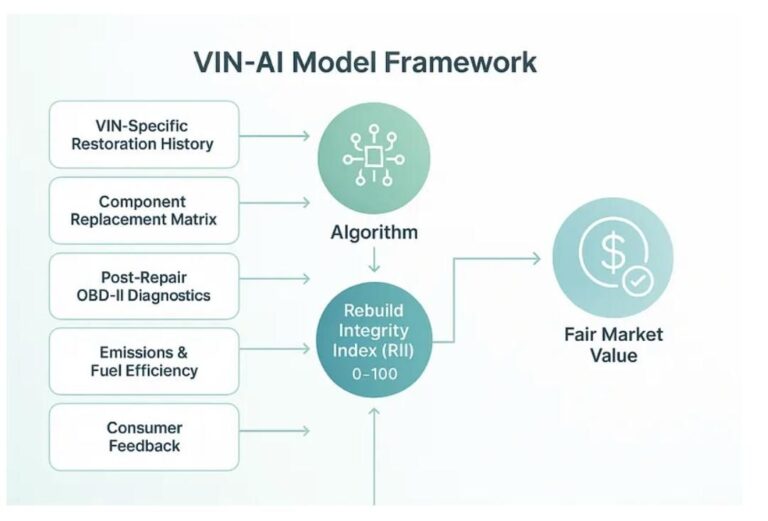
The framework integrates multiple categories of VIN-linked data, including:
-
Restoration provenance (auction source, damage classification, mileage differentials)
-
Component replacement matrices (OEM, aftermarket, refurbished)
-
Post-repair OBD-II diagnostic verification
-
Emissions and fuel-efficiency indicators
-
Performance or consumer feedback data, where available
These inputs collectively represent the technical state of a rebuilt vehicle beyond title classification alone.
3.2 Analytical Model
A multi-variable AI scoring architecture assigns each vehicle a Rebuild Integrity Index (RII) on a normalized scale from 0 to 100. Input variables are weighted according to engineering relevance, diagnostic reliability, and sustainability impact.
The model estimates Fair Market Value (FMV) using a normalized valuation function that adjusts conventional base pricing through traceable, data-driven logic rather than arbitrary stigma deductions. This approach replaces binary salvage discounts with continuous quality-based valuation gradients.
3.3 Projected System Benefits
Model simulations suggest that adoption of VIN-AI valuation frameworks could deliver:
-
Reduced price volatility (±5 percent) relative to current rebuilt-vehicle market spreads
-
Increased consumer confidence through transparent, verifiable data sources
-
Alignment with federal transparency and fair-competition objectives
4. Discussion
The VIN-AI framework demonstrates how existing diagnostic, insurance, and regulatory datasets can be repurposed into a digital trust architecture for rebuilt vehicles. Even as a conceptual model, it establishes objective criteria for valuation fairness and accountability.
Rather than penalizing all rebuilt vehicles uniformly, value determination becomes contingent on restoration quality verified through engineering evidence. For ethical rebuilders, this creates economic protection: professionally restored vehicles may recover 85–90 percent of intrinsic value, while undocumented or unsafe rebuilds remain appropriately discounted. This differential introduces market-based incentives for quality, transparency, and compliance.
5. Conceptual Implementation Roadmap
-
Data Standardization
Development of uniform VIN-repair reporting schemas compatible with OBD-II, EPA, and DMV records. -
Pilot Deployment
Voluntary participation by licensed rebuilders within state or regional registries. -
Algorithm Validation
Collaboration with academic or applied research institutions to refine weighting coefficients. -
Public Interface
Deployment of a consumer-accessible VIN query platform displaying verified restoration scores. -
Certification Integration
Alignment with emerging sustainability and green-manufacturing incentive programs.
6. Limitations and Future Research
The proposed framework is conceptual and assumes statistically meaningful correlations between technical restoration metrics and market value. Empirical validation will require cross-sector data-sharing agreements involving rebuilders, insurers, and regulatory agencies. Nevertheless, the model establishes a foundational structure for standardizing valuation logic and mitigating systemic bias against high-quality rebuild operations.
7. Conclusion
The integration of AI-driven valuation mechanisms into the rebuilt-vehicle market represents a necessary evolution rather than a speculative innovation. The VIN-based framework outlined in this study illustrates how data transparency can simultaneously enhance economic efficiency, environmental sustainability, and consumer trust. For independent engineers and rebuilders, adoption of standardized digital valuation models constitutes a critical step toward industry professionalization and formal recognition within the U.S. circular economy.
References (≤ 2024)
-
Federal Trade Commission. Motor Vehicle Trade Regulation Rule. 2023.
-
U.S. Department of Energy. Circular Manufacturing Policy Discussions and Technical Briefs. 2023.
-
U.S. Environmental Protection Agency. Market Transparency and Environmental Disclosure Resources. 2023.
-
National Institute of Standards and Technology. Automotive Remanufacturing Framework. 2023.
-
Tkachenko, V. Rebuilt, Not Replaced: Sustainability Economics of Vehicle Restoration (working manuscript). 2024.

- The Poem Hidden Inside Someone Else’s Page - July 20, 2026
- After 14 Years, We’re Finally Getting a James Bond Game - June 17, 2026
- Serhiy Tokarev on TechNovator’s Victory in Deep Tech Accelerator - June 9, 2026