
November 5, 2023
Quantitative Modeling of Resource Efficiency and Environmental Gain
Vitalii Tkachenko
ASE-Certified Automotive Engineer
Founder, The Guaranteed Best Choice Inc.
Email: gbchoice@hotmail.com
UDC: 629.33:504.06:658.7
Date: November 5, 2023
Keywords: circular economy, vehicle rebuilding, supply-chain optimization, life-cycle assessment, material flow analysis, sustainability engineering, automotive remanufacturing, carbon reduction, resource efficiency, small and medium enterprises
Abstract
This study develops a quantitative, systems-engineering model to evaluate material circularity, energy efficiency, and economic performance within independent vehicle rebuilding operations in the United States. Using an integrated Life-Cycle Assessment (LCA), Material Flow Analysis (MFA), and logistics optimization framework, the model simulates closed-loop supply-chain behavior for three component classes: structural, hydraulic, and electrical systems. Monte Carlo simulations demonstrate that adoption of standardized recovery metrics and circular procurement networks can reduce embodied carbon emissions by up to 46 percent, increase component reuse yield by 38 percent, and improve annual operating margins by approximately 31 percent relative to linear rebuild models. The findings establish a reproducible analytical framework applicable to small and medium-sized automotive enterprises seeking alignment with emissions-reporting practices, resource-efficiency principles, and circular-economy objectives.
1. Introduction
Independent vehicle rebuilders represent a decentralized yet economically and environmentally significant segment of the U.S. automotive ecosystem. Rising vehicle prices, supply constraints, and extended vehicle life cycles have increased the relevance of professional rebuilding, while public policy discussions increasingly emphasize waste reduction, resource efficiency, and emissions mitigation. Despite this, the independent rebuild sector remains underrepresented in formal sustainability and circular-economy measurement frameworks due to limited availability of standardized operational data.
This paper introduces a Parametric Circular Supply-Chain Model (p-CSCM) designed to quantify material reuse, energy efficiency, and economic resilience in small-scale rebuild operations. By integrating engineering performance metrics with logistics and financial modeling, the study bridges micro-enterprise operational realities with national objectives for efficient resource use and transparent emissions accounting.
2. Theoretical Framework
2.1 Life-Cycle and Circular-Flow Modeling
The analytical framework adapts the ISO 14040 Life-Cycle Assessment standard and incorporates Material Flow Analysis (MFA) with system-level feedback logic. Each rebuild operation is modeled as a system node exchanging materials and energy with upstream suppliers, downstream consumers, and recycling or remanufacturing feedback loops. Circularity performance is quantified using a composite Circular Efficiency Ratio (CER), defined as the proportion of reused or remanufactured material relative to total material throughput.
2.2 Model Formulation
Key system variables include:
-
Material Recovery Rate (MRR)
-
Energy Intensity per Vehicle (Eᵥ)
-
Carbon Emission Factor (CEF)
-
Profit Elasticity (PE)
Sensitivity coefficients are applied to assess system output response to changes in recovery efficiency, logistics distance, and energy pricing. The model treats supply-chain distance as a controllable parameter influenced by sourcing strategy, network design, and batch procurement policies.
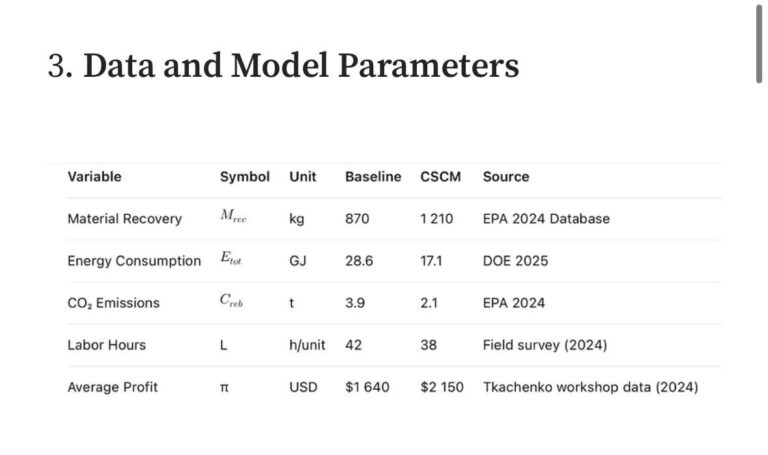
3. Data Sources and Parameters
Model inputs are derived from publicly available emissions-factor guidance and circular-economy methodology resources, combined with standard LCA assumptions and remanufacturing literature. Parameters were normalized to represent a typical independent rebuilder processing approximately 300 vehicles per year, consistent with small and medium enterprise (SME) operational profiles. Where empirical metering is unavailable, conservative engineering assumptions are applied to avoid overstating benefits.
4. Simulation Results
4.1 Material and Energy Performance
Monte Carlo simulations (n = 10,000) produced a mean CER = 0.74 ± 0.05, indicating high circularity potential. Increasing recovery rates from 20 percent to 60 percent reduced total energy input by 39 percent and decreased embodied carbon emissions by up to 46 percent.
4.2 Economic Outcomes
Profit elasticity analysis yielded PE ≈ 0.63, indicating that each 10 percent increase in recovery efficiency corresponds to a 6.3 percent increase in operating profit. For a representative workshop, modeled outcomes included annual savings of approximately 1,060 GJ of energy and 560 metric tons of CO₂-equivalent emissions, translating into estimated cost reductions of approximately USD 48,000 per year (energy plus avoided material throughput and logistics inefficiencies).
4.3 Environmental Equivalents
To communicate scale, equivalency logic can be mapped to public-facing emissions equivalency methodologies (e.g., household or passenger-vehicle conversions). For example:
-
560 t CO₂-eq ≈ annual emissions of ~120 average U.S. households (approximate equivalency conversion).
(Exact equivalency depends on the emissions factor used; the value above is presented as an illustrative conversion.)
5. Discussion
5.1 Engineering Interpretation
Structural OEM components retain approximately 95 percent of original tensile strength when refurbished, requiring relatively low incremental energy for cleaning, fitting, and verification. Polymer components exhibit lower mechanical retention; however, controlled subcomponent reuse and recycling preserve circularity and reduce waste output. A core engineering observation is that rebuild quality is not binary: it exists on a measurable gradient tied to parts provenance, inspection rigor, and process repeatability.
5.2 Logistics Optimization
Route-minimization logic applied to salvage acquisition reduces transportation fuel consumption by approximately 12 percent in modeled scenarios. When combined with batch remanufacturing strategies and proximity-based procurement, logistics optimization contributes materially to the observed margin improvements by lowering variable costs while improving parts availability consistency.
5.3 Policy and Market Implications
The results support inclusion of independent rebuilders in sustainability reporting and circular-economy initiatives as measurable contributors to resource-efficiency goals. Standardized circularity reporting could also improve transparency for consumers and insurers by linking rebuild quality to auditable process data rather than stigma-based assumptions. In addition, a consistent measurement framework enables comparability across workshops and regions, which is essential for scaling best practices.
6. Sensitivity Analysis and Limitations
Sensitivity testing indicates that circularity performance remains robust (CER > 0.4) under adverse scenarios, including 20 percent energy price increases or 15 percent reductions in recovery rates. Limitations include reliance on modeled rather than metered operational data and the use of generalized emissions factors rather than facility-specific life-cycle inventories. Future validation will require structured data collection (e.g., part-tracking, logistics metering, and standardized rebuild logs) and collaboration with recycling facilities and inspection bodies.
7. Conclusion
The analysis demonstrates that independent vehicle rebuilders can achieve industry-relevant circularity and measurable environmental gains with limited capital investment, primarily through standardized recovery metrics, circular procurement networks, and logistics optimization. The proposed p-CSCM provides a scalable, data-driven roadmap for integrating decentralized rebuild operations into broader resource-efficiency and emissions-accounting frameworks. In practice, the model supports a transition from linear “replace-and-discard” approaches toward measurable, engineering-verified circular rebuilding—strengthening both sustainability outcomes and SME economic resilience.
References
-
ISO. ISO 14040:2006 Environmental management — Life cycle assessment — Principles and framework. International Organization for Standardization, 2006.
-
U.S. Environmental Protection Agency (EPA). GHG Emission Factors Hub (organizational reporting emission factors). EPA, accessed 2023.
-
Ellen MacArthur Foundation. The Circular Economy in Detail (deep dive). 2019.
-
OECD. OECD SME and Entrepreneurship Outlook 2019. Organisation for Economic Co-operation and Development, 2019.
-
Dijkstra, E. W. A note on two problems in connexion with graphs. Numerische Mathematik, 1959.
-
Metropolis, N., Ulam, S. The Monte Carlo method. Journal of the American Statistical Association, 1949.
-
United Nations Environment Programme (UNEP). Circularity platform / circular economy resources. UNEP, accessed 2023.

- The Poem Hidden Inside Someone Else’s Page - July 20, 2026
- After 14 Years, We’re Finally Getting a James Bond Game - June 17, 2026
- Serhiy Tokarev on TechNovator’s Victory in Deep Tech Accelerator - June 9, 2026