
Roman Zao (Zakharchenko)
Independent artist-researcher in visual culture and tattoo art
Master of Fine Arts (Graphic Design), Far Eastern Federal University
Email: Roman.Zao.ink@gmail.com
ORCID: 0009-0003-5561-6339
UDC 77.03:316.7:391.91
30 March 2025
Keywords: photographic studies, tattooing, visual documentation, body art, social identity, visual culture, interdisciplinary art, visual anthropology
Within contemporary visual culture, tattooing increasingly exists not only as a bodily artistic practice but also as a visually fixed object disseminated through photography. Tattoo photographics occupies a distinct space between corporeal art, social communication, and visual representation, allowing it to be considered an independent interdisciplinary phenomenon.
This article examines tattoo photographics as a form of visual mediation between the body, art, and society. The focus extends beyond the tattoo image itself to include modes of fixation, representation, and interpretation within a socio-cultural context. In this framework, photography functions not as a neutral documentary tool but as an active participant in meaning production.
Research in visual studies and photographic studies emphasizes that photography inevitably transforms the object it records. In the case of tattooing, this transformation is particularly pronounced, as photographic representation detaches the tattoo from bodily movement and temporal dynamics, translating it into a stable visual sign. Consequently, tattooing operates simultaneously in two modes: as a corporeal artistic event and as a visual social artifact.
Tattoo photographics plays a crucial role in shaping the social visibility of body art. Through photography, tattooing transcends individual embodied experience and enters the public sphere. Visual documentation facilitates its inclusion in processes of social identification, aesthetic evaluation, and cultural legitimization. In this context, photography functions as a mediator between personal bodily choice and collective visual perception.
A defining characteristic of tattoo photographics is its intertypological nature. It exists at the intersection of multiple artistic and social systems, including body art, documentary photography, portrait practice, and visual anthropology. This hybrid positioning allows tattoo photographics to combine artistic interpretation, social documentation, and cultural testimony within a single visual framework.
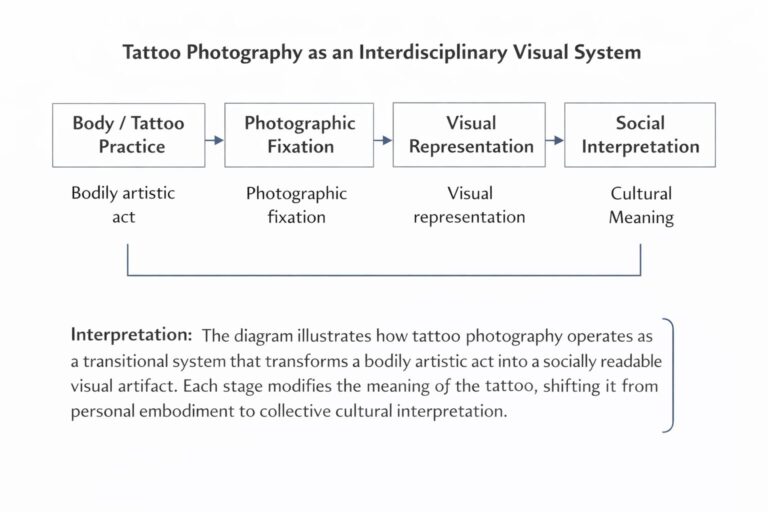
To conceptualize this interaction, the study employs the following analytical scheme.
Figure 1. Tattoo photography as an interdisciplinary visual system
This scheme illustrates the key feature of tattoo photographics—its capacity to alter the status of the artistic object. Once photographically фиксed, the tattoo ceases to function solely as a bodily element and begins to operate as an autonomous visual statement. This shift generates an additional layer of meaning that does not exist within exclusively corporeal perception.
Analysis of contemporary research and artistic practices demonstrates that tattoo photographics actively contributes to the normalization and institutionalization of body art. The circulation of tattoo images across media platforms, social networks, and exhibition contexts facilitates changes in public attitudes, relocating tattooing from marginal status into the field of recognized visual art forms.
In conclusion, tattoo photographics may be understood as an independent art–social–cultural phenomenon that integrates bodily practice, visual representation, and social meaning. Studying this phenomenon expands the understanding of tattooing as a form of contemporary art and reveals new mechanisms through which the body, image, and society interact within modern visual culture.
References
-
Batchen, G. (2004). Forget Me Not: Photography and Remembrance. Princeton University Press.
-
Edwards, E. (2012). The Camera as Historian: Amateur Photographers and Historical Imagination. Duke University Press.
-
Rose, G. (2016). Visual Methodologies: An Introduction to Researching with Visual Materials (4th ed.). Sage.
-
Pink, S. (2013). Doing Visual Ethnography (3rd ed.). Sage.
-
Mitchell, W. J. T. (2005). What Do Pictures Want? The Lives and Loves of Images. University of Chicago Press.
-
DeMello, M. (2014). Inked: Tattoos and Body Art around the World. ABC-CLIO.
-
Jones, C. A. (2011). Body Art/Performing the Subject. University of Minnesota Press.
-
Banks, M., & Ruby, J. (2011). Made to Be Seen: Perspectives on the History of Visual Anthropology. University of Chicago Press.

- The Poem Hidden Inside Someone Else’s Page - July 20, 2026
- After 14 Years, We’re Finally Getting a James Bond Game - June 17, 2026
- Serhiy Tokarev on TechNovator’s Victory in Deep Tech Accelerator - June 9, 2026