
Valeriia Guznenkova
ORCID: 0009-0008-6150-7311
November 18, 2024
Abstract
This article explores posing as a structural element in photographic image construction. The research is based on applied photographic practice and focuses on how body positioning influences the perception of form, proportion, and visual balance.
At this stage, the study does not propose a fully formalized method, but rather documents a developing approach in which posing is no longer treated as a decorative or stylistic addition, but as a primary tool in shaping the image. The findings suggest that controlled posing can significantly alter both the visual outcome and the subject’s perception of their own body within the frame.
Keywords
posing, composition, visual structure, female body, photography, perception, body representation, contemporary photography
Introduction
In most contemporary photographic practices, posing is treated as a secondary element — something that supports the image rather than defines it. It is often reduced to a set of familiar positions or aesthetic references that are repeated across different shoots.
At the same time, the final image is frequently shaped through post-production, where proportions, lines, and visual balance are adjusted after the fact. This creates a situation in which the actual position of the body during the shoot becomes less significant.
However, during practical work, it becomes evident that even minimal changes in body positioning can dramatically alter how the image is perceived. This observation raises a question: can posing be understood not as decoration, but as structure?
Research Context
The starting point of this research was a series of practical shooting sessions in which different approaches to posing were tested. Initially, posing was approached intuitively, often influenced by existing visual references.
Over time, a pattern began to emerge. Certain adjustments — a slight shift in weight, a change in angle, a repositioning of the shoulders — consistently affected the clarity of the image.
These changes did not depend on editing. They were visible immediately, within the frame.
This led to a gradual shift in focus: instead of searching for “beautiful poses,” the attention moved toward understanding how the body functions as a structural element within the image.
Research Objective
The objective of this study is to examine how posing can function as a tool for constructing visual structure in photography.
The research focuses on identifying the relationship between body positioning and key visual elements such as line, proportion, and spatial balance.
Methodology
The study is based on applied photographic practice. A series of controlled shooting sessions were conducted, where posing was intentionally adjusted and observed in real time.
The methodology includes:
- comparative observation of different body positions within the same setting
- analysis of how small positional changes affect visual perception
- documentation of subject reactions during the process
At this stage, the research remains observational and exploratory rather than strictly experimental.
Posing and Visual Structure
One of the key observations is that posing directly influences the structural clarity of the image.
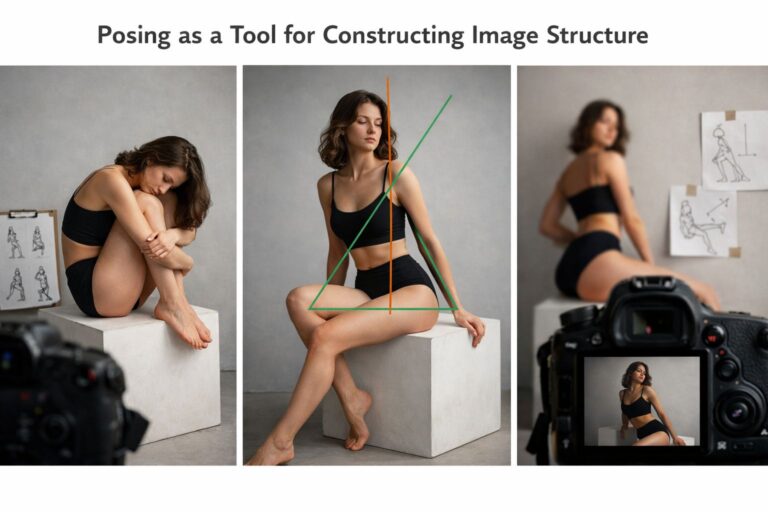
The body, when placed within the frame, creates lines and directions. These lines determine how the viewer reads the image. A slight bend or extension can either disrupt or reinforce the visual flow.
For example, a compressed posture often results in visual heaviness, while an extended line creates a sense of length and openness. Similarly, the position of the shoulders and hips defines the direction and tension within the frame.
These effects occur regardless of post-production. They are inherent to the positioning itself.
From this perspective, posing becomes less about appearance and more about construction.
Perception and the Subject
Another important aspect of this research is the subject’s experience during the shoot.
When posing is treated as a structural process, the subject shifts from trying to “look good” to following precise directions. This reduces uncertainty and changes the internal dynamic of the session.
Many subjects report that they feel less focused on evaluation and more engaged in the process. They begin to perceive their body not as something to judge, but as something to position.
This shift, although subtle, appears to influence both comfort and confidence.
Emerging Patterns
Several recurring patterns were identified during the sessions:
- extended lines tend to produce a clearer and more structured image
- asymmetry often creates visual interest but requires careful control
- tension in the body can either enhance or disrupt the composition depending on its direction
- uncontrolled posing leads to visual fragmentation
These observations suggest that posing is not arbitrary. It follows certain visual principles, even if they are not yet fully formalized.
Discussion
At this stage, posing can be understood as a transitional element between intuition and system.
It is not yet defined as a complete methodology, but the consistency of the observed patterns indicates that it can be developed into one.
The research suggests that treating posing as a structural tool may shift photographic practice away from correction-based approaches and toward real-time image construction.
Conclusion
This study demonstrates that posing plays a more significant role in image construction than is commonly assumed.
Rather than functioning as a decorative addition, it can serve as a primary mechanism for shaping visual structure.
While the findings are still exploratory, they indicate the potential for developing a more structured approach to posing in photography — one that could redefine how images are constructed and perceived.
References
- Arnheim, R. (2022). Art and Visual Perception Revisited. University of California Press
- Berger, J. (2023). Ways of Seeing in the Digital Age. Penguin
- Manovich, L. (2023). Cultural Analytics. MIT Press
- Flusser, V. (2022). Into the Universe of Technical Images. University of Minnesota Press
- Sontag, S. (2023). On Photography (Updated Edition). Farrar, Straus and Giroux

- The Poem Hidden Inside Someone Else’s Page - July 20, 2026
- After 14 Years, We’re Finally Getting a James Bond Game - June 17, 2026
- Serhiy Tokarev on TechNovator’s Victory in Deep Tech Accelerator - June 9, 2026